While the main assault was taking place on
Omaha Beach, Companies D, E and F of the 2nd Ranger Battalion were engaged in
a solitary action, 5 kms to the west.
Under Lt.Col. James E. Rudder, the 225 Rangers had a very special mission to
accomplish at the Pointe du Hoc: capture that fortified postion and neutralize
the 6-guns 155mm battery that was capable of firing on all the approaches to
Omaha and Utah. The layout of the terrain was making this mission particularly
difficult: a 25m-wide strip of beach overlooked by a 30m high cliff that would
have to be climbed.
It was around 0430 hrs that the ten
LCAs and four DUKWs carrying the troops had been lowered from the transport
ships about 20 kilometres off the coast. Each LCA was equipped with rocket-propelled
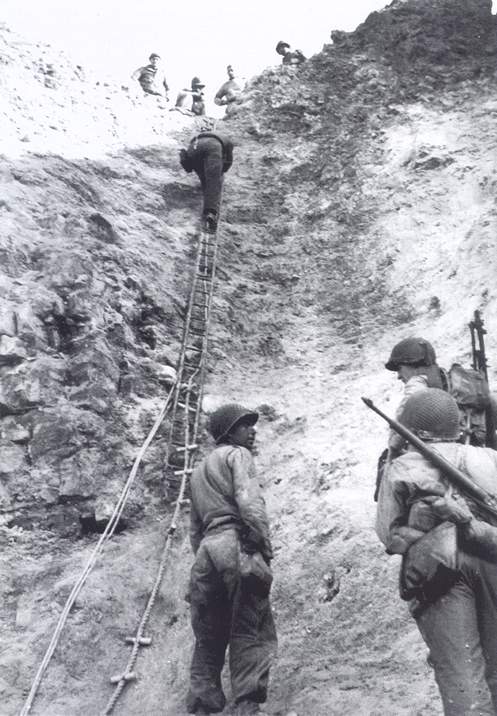
knotted climbing ropes and rope ladders that would be used to climb the
cliff. Each landing craft was also carrying extending ladders made of
several sections that could be easily assembled to each others while each
DUKW were carrying 110-foot long firemen' ladders.
The attack plan was that, at H-Hour, D Company would land to the west
of the Pointe while E and F Companies would land to the east of it, and
then they would neutralize the battery emplaced on top.
Due to strong tide currents and low
visibility, the british control boat mistook to Pointe de La Perçée
for the objective, 2km to the east. This forced the Rangers to navigate
along the coast under the german fire which sank one of the DUKWs. Previously,
one of the LCA had already sunk in the rough sea near the start line.
This navigation error caused a 40 minutes
delay on the planned schedule and the follow-up Rangers companies, without
any news from Rudder, would be redirected to Omaha Beach.
Climbing the Pointe du Hoc
( USA Signal Corps )
At 0710 hrs, the 9 remaining LCAs reached
the eastern side on the cliff on a 400m-wide front and the Rangers landed
on the narrow strip of beach. In less than 5 minutes, the first men were
already on top of the cliff and, after regrouping into small squads, they
moved towards their assigned objectives. They reached the battery emplacements
but found no guns inside them. Without stopping, they carried on with
their mission and pushed inland to cut the coastal road, establish a defensive
perimeter and await for the reinforcments coming from Omaha Beach.
The patrols started around 0900 hours.
Following a path beyond the coastal road, two Rangers found the guns in
a field as well as a large amount of ammunitions but with no german soldiers
around. They destroyed two of the guns with hand grenades and then retraced
their steps to fetch some more. Another patrol finished up the job and
blew up the ammos.
After a while, the enemy began to recover
from the early confusion and mounted several counter-attacks during the
day. The small group of Rangers back at the battery was besieged and only
with sporadic contact with advanced group near the road and the Command
Post couldn't establish communication with the main attacking forces on
the beaches.
During the afternoon, only a single message could be sent to V Corps from
the Pointe du Hoc: "Here is the Pointe du Hoc - missions accomplished
- need ammos and reinforcements - casualties heavy".
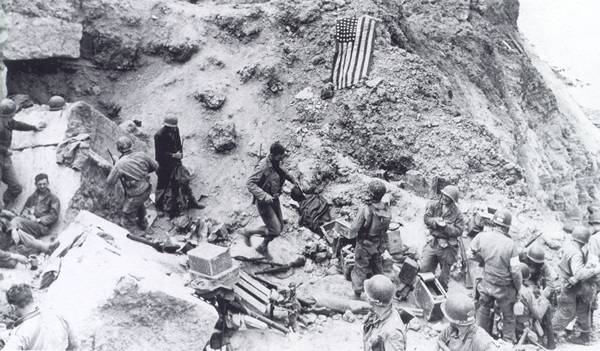
This situation lingered on June 6th and 7th, the Rangers dug in and awaiting
the reinforcements from Omaha.
Rangers at the Pointe du Hoc
( USA Signal Corps)
It's only around noon on June 8 that
the relief forces, made of the 5th Ranger Battalion, the 116th Infantry
Regiment and tanks from the 743rd Tank Battalion forced the germans to
withdraw toward Grandcamp and the Rangers were able to take a short rest.
During this assault, the 2nd Ranger Battalion suffered 135 losses out
of the 225 men that landed. On June 8 at 1200 hrs, only 90 men remained
fit for duty.