
|
|
| L'Assaut | La Journée | Les Cartes | Men of D-Day | Photos |
|
|
|
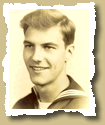
LCI Flotilla Two (32 ships) left Torquay England early June 6 or June 5 with troops and barrage balloons and proceeded to Utah Beach. Each ship carried about 125 fully armed infantrymen in heavy seas. Just after daybreak, we reached
a marked (by bouys) supposedly swept lane to head for the beaches.
An LCT (#777) cut across our starboard bow and was several hundred
feet ahead when it struck a mine. The bow went straight up spilling
6-bys trucks and personnel into the channel. It sank in a few minutes.
We picked up a sailor with his life jacket on but unconscious or
dead and our corpsman worked on him over an hour while the ship
was bucking in heavy sea but to no avail. We transferred the body
to a troop ship later. A group of LCVP's came along side and took our troops off and took them in. German shore guns walked out to us in several places when we first tried but air cover kept them inoperative in most cases. We never had to look up when a plane flew over. The German Airforce was finished except for a few that came at night. We had to tie up to a Liberty
ship after loosing bow and stern anchors. At night on D-7, the line
we used to tie to the Liberty broke and we started engines and not
knowing the line had broke at the Liberty and the line came under
our ship and fouled the screws shutting down the engines. We drifted
to shore going between the steel obstacles and finally going high
and dry at low tide. Fortunately the shore batteries had been destroyed. After that we were used for
hauling troops and supplies from various points on the Normandy
beaches and finally we took a load of walking wounded to England
on June 22-23. Thanks for the opportunity. |
||||||||||||||||||||||||||||||||||||||||||||||||||||||||||||||||||

 Omaha
Beach
Omaha
Beach
 Utah
Beach
Utah
Beach 82nd
Airborne
82nd
Airborne Troop
Carrier
Troop
Carrier 101st
Airborne
101st
Airborne 6th
Airborne
6th
Airborne

 U.S.
Air Force
U.S.
Air Force
|
|