
| The Assault | Timeline | Maps | Men of D-Day | Photos |

|
Narrative Account : DOERING, Evader Pilot : 1st Lt. Harvey W. DOERING We were the crew of a C-47 troop carrier sent to drop a stick of paratroops over STE MERE EGLISE early in the morning on D-Day. We dropped our load on schedule, but missed our course in the overcast and were hit by heavy flak after turning N to return to our base. The port engine and part of the wing were blown away. As we were flying low, we could only crash land in a field. It was about 0131 hours. We were cut up a bit, but not badly hurt, though the plane groundlooped and broke up. We destroyed the radio equipment, set fire to the plane and then went to hide in a ditch, as we heard some Germans with dogs nearby. We stayed there until 1000 hours the next morning, when two Frenchwomen passed. We went up to them and told them we were Americans. The elder one smiled and motioned us to wait. Later they came back with food and showed us a better place to hide. We stayed there for two days and nights, hiding in various places in the neighborhood. The Frenchwomen showed us hedges and haystacks, and fed us from time to time. They also gave us blankets at night, at it was very cold. We had K and C rations, too, and used some of the things in our escape kits. On the third day our helpers were accompanied by aman called EMILE FERY, who was section chief of police in the nearby town of EQUEURDREVILLE, a suburb of CHERBOURG. He brought us civilian clothes, which we put on over our uniforms, and then took us in his car to his house. This man stood in well with the Germans, who allowed him to drive wherever he wanted. His house as never searched by the Germans all the time we were there. We stayed quietly in the house all the time we were there, playing cards and cleaning up. Soon we heard the American guns drawing nearer and nearer. The last few days shells fell nearby, and we could also hear the Germans blowing up the port installations, though we could not see the harbor from Emile's house. The last two days we spent under a large table, as there was no cellar in the house, and the gunfire was incessant. We only moved from there when we had to eat. Emile had plenty of food and wine in the house, mostly black market stuff. Several other Frenchmen who had been active in the Resistance movement ran in to give us news. Among them were the Mayor of the village, a man called Alex. Another friend of Emile's, Pierre ROEMER, the Gaulliste agent in hat neighborhood, also came to see us several times and told us he had killed several Germans. The first US patrol came through on the 25th after dinner. Emile was out. We heard the US troops talking as only G.I's can, and went out and showed them our dogtags. They sent us back to 9th Div. headquarters, where we were interviewed briefly by Capt. Jackson. Then we were sent to VII Corps Hq, where a 2nd Lt. interrogated usin the presence of some 20 war correspondents, who took lots of notes. He also introduced us to Collin WILLS, a BBC broadcaster, who heard our story and wrote a script which we recorded in a field nearby. He gave us the attached copy of this script, which was broadcast the next day, we understood. A French captain, the liaison officer, also talked to us. He said he knew Emile and the mayor of EQUEURDREVILLE well. The Air Liaison Officer took us down to a landing strip next day, and we were flown back to our base from there. The effects of the shelling we had been through did not really begin to show themselves until we were back in England. They put us in the hospital and we had a good sleep. Incidentally, Emile still has a wife and two children in German occupied ROUEN. Theodore M. Purdy (30 June 1944) Appendix D : |
 Troop
Carrier
Troop
Carrier

 82nd
Airborne
82nd
Airborne
 101st
Airborne
101st
Airborne Utah
Beach
Utah
Beach
 Omaha
Beach
Omaha
Beach Gold
Beach
Gold
Beach Juno
Beach
Juno
Beach Sword
Beach
Sword
Beach 6th
Airborne
6th
Airborne

 U.S.A.A.F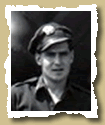
| |