
| The Assault | Timeline | Maps | Men of D-Day | Photos |

|
Narrative Account : HENDRY, Evader 1. 2nd Lt. JOHN H. HENDRY, navigator of A/C 638, was picked up by this organization at Hendon Field, London, 1000 hours 22 June 1944. The report on Lt. HITZTALER, pilot of A/C 638, was submitted through channels earlier this date. The following is Lt. HENDRY's first person account : I was lost upon re-crossing the coast line back into the Cherbourg peninsula. The searchlights had picked us up. The A/C was in pretty bad shape and Lt. Hitztaler was taking evasive action. One of the enlisted crew members was critically injured and was lying in the passage way at my feet. His hands which were touching my trouser leg grew limp. We were up around 2500 feet when Lt. Hitztaler gave us the order to bail out. I had been previously holding up a flak suit against the windows in the pilot's compartment to keep the glare from the lights out. I picked up my chest pack from the baggage compartment and went out the back way. I saw the copilot Lt. Edwards and one of the enlisted crew members bail out. The wounded paratrooper was going up to get his chute as I left. I landed in the vicinity of Negreville approximately 0315 hours. My chute was caught in a tree so I got away fast and took a cowpath down to the main road. I looked carefully up and down for a few moments and finally took the main road heading northwest. I walked until about 0600 or 0630 ours when it got too light to travel. I only had to duck into the ditch twice when German transports passed me by going in the opposite direction. Daylight found me within two kilometers of Sottevast, which is ten kilometers west of Valognes. I hid in a barn, which had a hayloft, for the whole day, and that night went to the nearest farmhouse. I crossed the doorstep and accosted the Frenchman. In my best high school French I informed him who I was and the fact that I had parachuted out the night before. He regarded me suspiciously for approximately five minutes and examined me closely but then gave me food and lodging. A friend of him came the next day and put me in an abandoned German dugout, which had been used as a flak installation. Later he brought me straw, a blanket, and sweaters. He used to come three times a day with food and shaved me once every three days. I had determined to sit tight and wait for American troops. On Saturday, the 17th of June, Captain Harry Downing of the 411 Fighter Squadron, 373 Group, a P-47 pilot, was brought into the dugout by the French who had equipped him with civilian clothing in order to get him there. While we were there we could see the P-47's bomb the Sottevast railroad station and they also attempted to knock out flak installations in the vicinity; however, they were not very successful because the installations were very cleverly camouflaged. On Monday, or rather, Tuesday the 20th, we heard that the Americans were one kilometer down the road. So the Frenchmen escorted us to the front line where an M8 vehicle carried us back to their brigade command post. From there we were taken to the Seventh Division headquarters and then to Corps headquarters. Then we were taken to General Bradley's headquarters where we were supposed to be personally interrogated by him. However, it seemed to have been forgotten and a jeep took us to a dirt landing strip, which was being used for air evacuation. We caught a C-53, ATC ship 033, which had been loaned to a naval admiral, and taken to Hendon Field. At each of the headquarters to which we had been taken we were interrogated by G-2's and S-2's. At the fighter wing headquarters at Carentan Lt. Col. Bobby Jones did the interrogating. 2. In addition to the foregoing information the following was derived from special interrogation by the undersigned officer : James F. Shemas (22 June 1944) |
 Troop
Carrier
Troop
Carrier

 82nd
Airborne
82nd
Airborne
 101st
Airborne
101st
Airborne Utah
Beach
Utah
Beach
 Omaha
Beach
Omaha
Beach Gold
Beach
Gold
Beach Juno
Beach
Juno
Beach Sword
Beach
Sword
Beach 6th
Airborne
6th
Airborne

 U.S.A.A.F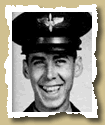
| |