
| The Assault | Timeline | Maps | Men of D-Day | Photos |

|
Narrative Account : HITZTALER, Evader 1. 1st Lt. WILLIAM R. HITZTALER, pilot of A/C 638, was picked up by this organization at Bisterne Field, a P-47 base, 2000 hours, 21 June 1944. His narrative account follow : Coming in over the coast we received machine gun fire. Then we hit low clouds or heavy smoke. Trying to follow Captain Harruff, leader of the first flight, we pulled up and then down through the clouds, veering to right slightly so as not to run into them. I could not find them upon emerging so I took up the proper course heading. In approaching the DZ, our A/C encountered flak fire which hit toward the rear and the tail. One paratrooper was badly hurt and was believed dying. I gave the green light at the proper time, just short of the river. I noticed a large fire to the left which may have been the T. We started climbing and went up to 3000 feet going out. The plane seemed to be flying okay but on turning north the A/C began veering to the left. The vertical controls wereall right but the rudder control was jammed. I decided not to ditch the A/C because I believed that the dinghies had been shot full of holes since we had received fire in the tail, and secondly it was my impression that several members of the crew could not swim. As I neared the coast four searchlight batteries picked me up. I then began receiving accurate and intense light flak, and machine gun fire. I tried to get into the clouds at 1500 feet, succeeding in losing the searchlights but the A/C continued receiving flak. I tried to gain altitude but at this time the instrument pannel and part of the controls were shot away by a light flak burst. At 2500 feet I gave the order to bail out, at 0315 hours. My approximate position was six to eight miles south of Cherbourg and west of Negreville. One of the crew had been wounded, but I was the last to leave the A/C and at that time no one was left in the crew compartment. All other members went out the rear door, but I did not have sufficient time left. Evidentally we had lost altitude and because my instrument pannel had been shot out I did not know whether I was flying right side up or not. Therefore I hooked on my chest pack and went out the escape hatch. As I went out I noticed the trailing edge of the left wing was on fire. I do not recall any details of the bail out except that I did not hit any parts of the plane. I do not even remember pulling the rip chord. But the chute must have just opened when I hit the ground because I received a very heavy jolt. It was still dark and I could see no one from the balance of the crew. I had landed in a wheat field surrounded by hedges and ditches and German antiaircraft positions were all about. One was situated on the field no more than 25 to 50 yards away and I could hear them talking. Therefore I dared not move and remained in that spot for over two days. I lay under a tree and wheat with only a light sweater and the parachute for protection against the cold and the rain. I had not had sufficient time to pick up my leather flying jacket and escape aids from the compartment on leaving the plane. Despite no care the bullet crease on my right leg and the flak wound on my left shin seemed to heal satisfactory. I did not notice that my arches had been injured on landing untilI started to leave. I had grown very hungry and determined to make an effort to get to the American lines. I skirted the hedges toward a farm house after burying my parachute, and signaled to a farmer in a field. He motioned to duck and greed heartily. And he went to the house and brought me a loaf of bread, two boiled eggs, a half pound of butter, wine, and French whiskey, which I mistook for water. He gave me civilian trousers and jacketand shetered me in his home until a guide came the next day. I was taken to a little village where I spent the night in a house and then was transferred to another home for the next night. An old man, his wife, and three children were the occupants of this house who cared for me.Later in the day two men came for me on bicycles. I didn't like the idea but I finally accompanied them down the main road on bicycles past German vehicles and soldiers. I noticed that all their artillery was horse drawn and on wheels. They took me to a large barn like building which may have been a wine press, near the town of Yvtot Boucage, where I joined three glider pilots and four airborne troopers who had landed near the west coast and who had been assisted to the place by the French. Across the road were refugees from Valogne and one old lady sewed up my trousers which had been ripped on leaving the plane. We stayed in the barn four or five days and were continually cared for by French people. We slept in the hayloft and had a latrine in the building. We couls watch German traffic on the main road outside. An American infantry scouting platoon which had advanced nine miles that morning surrounded the barn covering us with their weapons and ordered us out. SinceI had civilian clothes I was very carefully interrogated by the lieutenant in charge. During the process the barn began receiving German mortar fire which was zeroing in. The lieutenant ordered us to deploy across the field and to get the machine guns which were now firing at us. We crawled to a ditch under fire and the hedge concealing it was cut hte ribbons. Although the glider pilots had hesitated n following the airborne troopers who had thrown in with the infantry platoon. I had my .45 pistol but didn't have a chance to use it because the platoon decided in withdrawing several kilometers to the south which was direction we desired to travel anyway. This was the 19th of June. We met advancing American infantry about a half mile down the road from the hot spot. There the platoon left us but we continued to the rear to report to a divisional command post, where the Intelligence officer interrogated us for any information we had about the enemy. The identity of the division is unknown to me except that it had relieved the Ninth Division and its name ended in nine. From there we hitched hiked to the coast and caught a jeep ride to the beach. We were unable to get back immediately so I returned to the vicinity of Ste Mere Eglise. James F. Shemas (22 June 1944) |
 Troop
Carrier
Troop
Carrier

 82nd
Airborne
82nd
Airborne
 101st
Airborne
101st
Airborne Utah
Beach
Utah
Beach
 Omaha
Beach
Omaha
Beach Gold
Beach
Gold
Beach Juno
Beach
Juno
Beach Sword
Beach
Sword
Beach 6th
Airborne
6th
Airborne

 U.S.A.A.F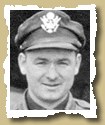
| |