|
 |
Pathfinders went in First
|
Genesis - Creation of a Scout company
Taking up quarters in Oujda in early 1943 (French Morocco), the 2/503rd, newly renamed 509th Parachute Infantry Battalion, drew the conclusions of its two combat jumps on 8 and 15 November 1942 in North Africa (not counting the raid by 32 of its men on El Djem on 26 December 42), and came to the natural conclusion that it was not possible to drop a significant number of troops behind enemy lines without first having marked, identified and relatively secured the area on the ground.
Lt. Col. Doyle Yardley, in charge of the 509th (replacing Raff and Yarborough, who were called away on other missions), decided to form a "Parachute Scout Company", composed of three platoons of two squads each, with eight men per squad. He received support from Lieutenant-Colonel Charles Billingslea, in charge of Airborne training in Oujda.
Yardley intended to use this company in future operations to precede the invading airborne forces, with the mission of marking DZs using Aldis lamps (high-powered portable lamps), flares, and smoke. He borrowed from the British 21st Independent Parachute Company, formed in June 1942, the techniques for sending and receiving electronic signals to guide aircraft to DZs.
A few months later, on July 9 and 11, 1943, the 504th and 505th Parachute Infantry Regiments of the 82nd Airborne Division dropped onto southern Sicily as part of Operation Husky. No scouts, pathfinders, or reconnaissance units were deployed, and the drops proved disastrous, with pilots and jumpmasters having only the memory of studying maps and photographs to guide them....
Salerno - The first combat jump
The decision to use the Pathfinders was made in the late summer of 1943, after meetings held in Comiso, Sicily between Colonel James Gavin,
Commanding Officer of the 505th Parachute Infantry Regiment, Major
Bernard 'Boy' Wilson, Commanding Officer of the British 21st Independent
Parachute Company and Lt. Col. Joel L. Crouch who, by this time, was A-3 of
the 52nd Troop Carrier Wing. Initially it was conceived that they
would establish and train personnel for one mission only, Normandy operations,
and that all personnel would be assigned to the Pathfinder school on « temporary
duty ».
During the nights of 13 and 14 September 1943,
aircraft from the 52nd Troop Carrier Wing dropped paratroopers of
the 82nd A/B Division near Salerno to help and reinforce the Fifth
Army.
Three aircraft of the 52nd TCW Hq (4 C-47 and 1 C-53 type aircraft
are assigned to the Hq by this time) were used as Pathfinder aircraft for each
drop. On 13 & 14 september, Lt. Col. Joel L. Crouch was at the controls
of the lead pathfinder aircraft. On the night of September 13 to 14, Colonel
Harold L. Clark was co-pilot and, on the night of September 14 to 15, Lt. Col.
Dick R. Petty held this position. The first night they dropped elements of the
504th Parachute Infantry Regiment while, the second night, it was
elements of the 505th Parachute Infantry Regiment.
It was the first time that pathfinders
were used in combat and the first aircraft to drop pathfinders was
Douglas C-53D #42-68810 assigned to the 52nd Troop Carrier Wing Hq.
Her crew was :
Pilot : Lt. Col. Joel L. CROUCH
Co-Pilot : Col. Harold L. CLARK
Navigator : 1st Lt. James W. BODDIE
Radio Operator : T/Sgt. Charles W. STUART
Crew Chief : T/Sgt. Clarence W. NIELSEN
Observer : 2nd Lt. Cecil W. BIGGS
In March 1944 Lt. Col. Joel L. Crouch will be in
charge of the IX Troop Carrier Command Pathfinder School which was formed and
established at North Witham airfield. It was from this base that the 20 Pathfinder
aircraft took off during the night 5 / 6 June 1944 to deliver paratroopers from
the 101st and 82nd A/B divisions to mark the DZs which
will be used by the main force, 30 minutes later.
Operation Neptune - Missions Albany and Boston
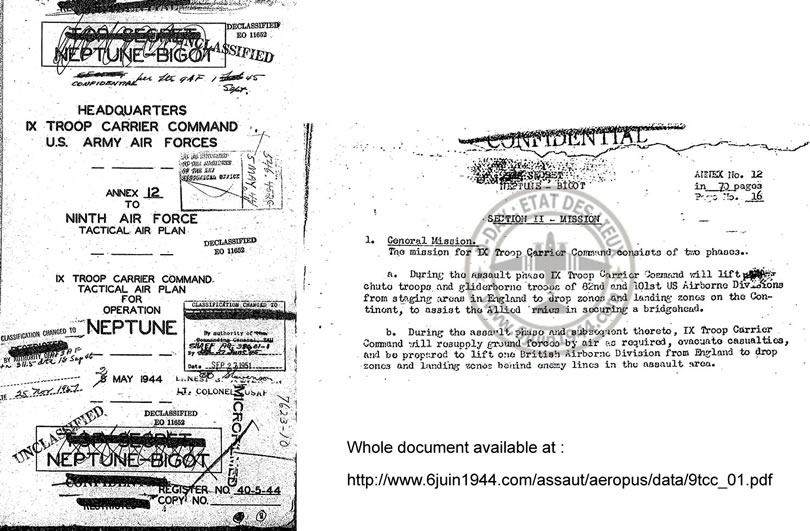
Published on May 2, 1944 the IX Troop Carrier Command
Tactical Air Plan for Operation Neptune give the task to the IX Troop Carrier
Command to deliver the two American Airborne divisions, 82nd A/B
and 101st A/B, in the Cotentin Peninsula to protect the west flank
of the landings area.
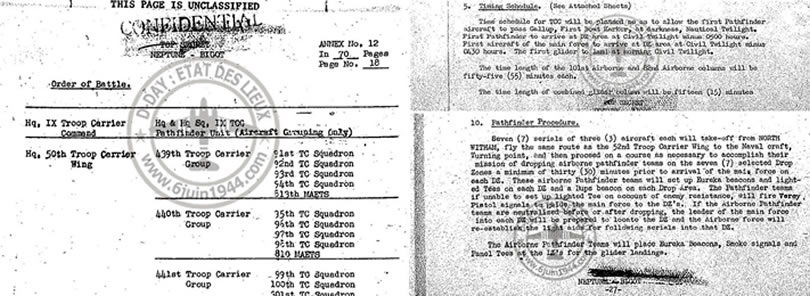
The Order of Battle of the IX Troop Carrier Command,
always in the Tactical Air Plan, include the Pathfinder unit as part of the
Hq IX TCC. Pathfinders were not a separate unit and pathfinder teams were made
of men who voluntered or were choosen to be part of these teams and were from
the 101st and 82nd A/B divisions. After the jump of
the main body the men of the pathfinder teams were to return to their parent
unit.
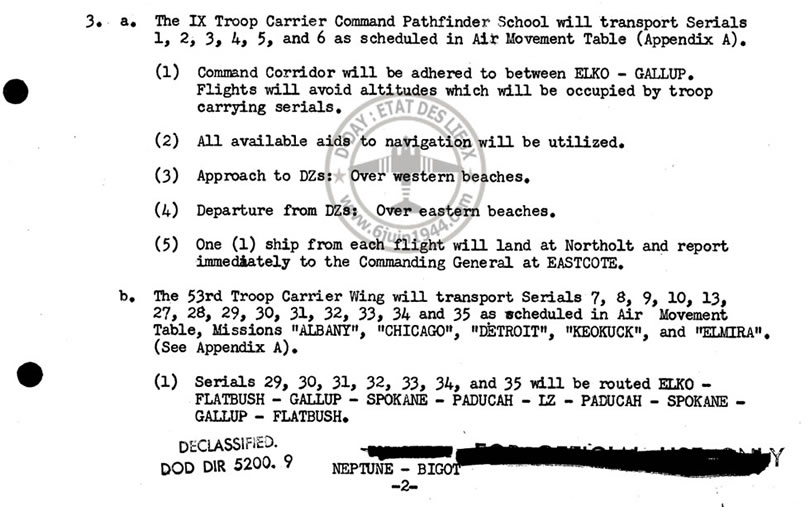
The same Tactical Air Plan for Operation Neptune
explain the use and role of Pathfinder aircraft and Pathfinder teams. Field order #1, Hq IX TCC, published on May 31, 1944 confirm the
use of Pathfinder aircraft and that they will be in the first serials of the
invasion.
Appendix D1 to IX T.C.C. F.O. #1 or Time schedule for the missions list also
Pathfinder aircraft as the lead aircraft of the IX Troop Carrier Command for
operation Neptune.
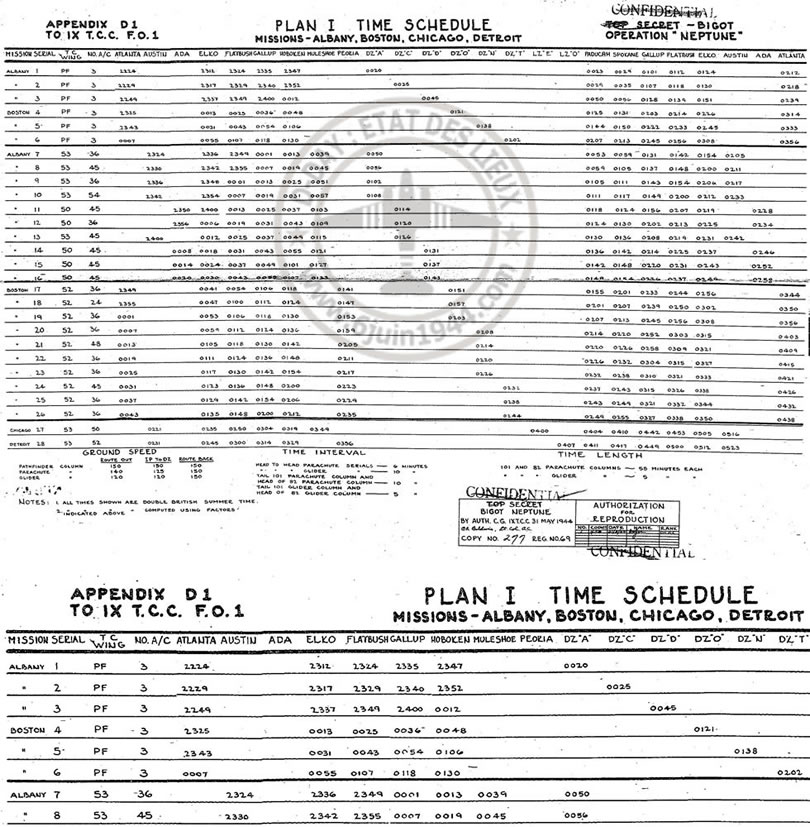
A last minute change was made and a Serial 6a was included. Two pathfinder
teams will be dropped on DZ 'C' with the task to mark the LZ 'E' which will
be used by the first glider mission. Time over DZ for this serial 6a : 00:27
BDST
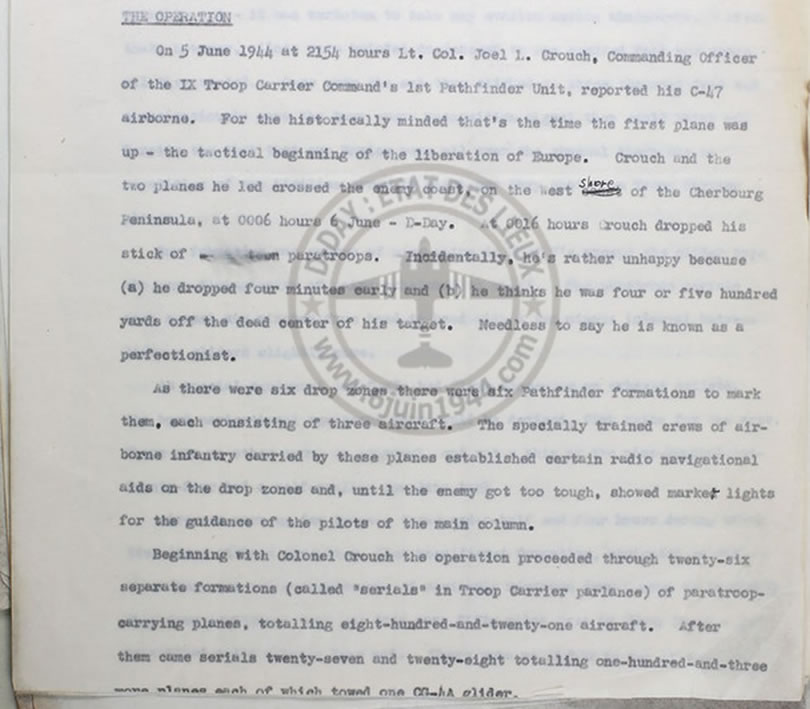
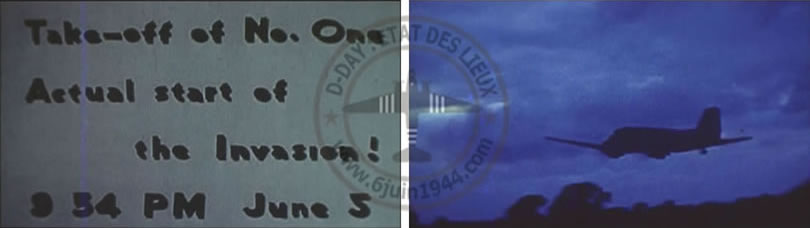
Of course, on D-Day, Lt. Col. Joel L. Crouch was
in the left seat of the first Pathfinder aircraft to take off, at 21:54 BDST
from North Witham. After an uneventful flight over the Channel, he crossed the
west coast of the Cotentin Peninsula at 00:06 BDST and dropped his troops from
the 101st A/B division at 00:16 BDST, four minutes ahead of schedule.
This aircraft was the FIRST aircraft of the IX Troop Carrier Command
to fly and drop paratroopers of the 101st A/B division over Normandy. The Lead
Aircraft !
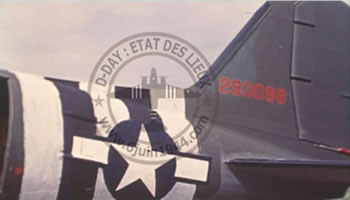
Aircraft flown by Lt. Col. Joel L. Crouch and his crew was C-47A-20-DK #42-93098.
The aircraft, like the 19 other pathfinder aicraft and serial leaders of the
main wave, was equiped with navigational aids, Radar SCR-717, British Gee and
Rebecca system.
 |
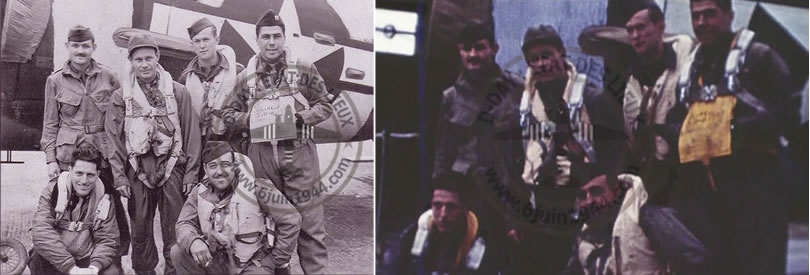
Her crew was :
Pilot : Lt. Col. Joel L. CROUCH
Co-pilot : Capt. Vito S. PEDONE
Navigator : Capt. William K. CULP
Radio Operator : Cpl. Harold E. COONROD
Crew Chief : S/Sgt. Edward F. LAURENDEAU
Surgeon : Capt. Edward E. CANNON |
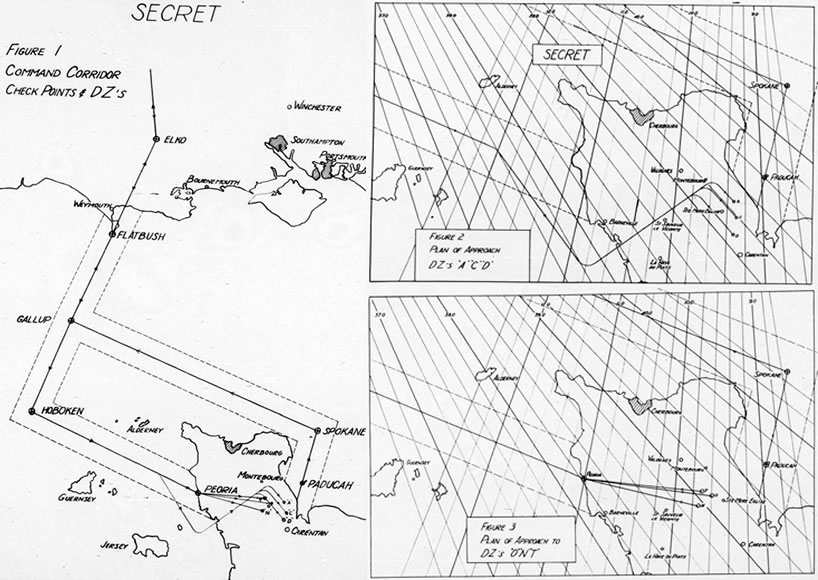
The twenty pathfinder aircraft left the English coast at the waypoint coded Flatbush and the Channel crossing was carried out, according to David Hamilton, one of the pilots, in close formation and about fifty feet above the waves in order to avoid detection by German radar.
The SCR-717 radar was used to pass equidistant between the islands of Guernsey and Alderney and confirm the Initial Point of entry to the Normandy coast. This same radar was used by pathfinder Aircraft #4 to locate the destroyer HMS Tartar, next to which she would make her forced landing after her mission had aborted.
The aircraft also used the GEE system to guide themselves to their drop zone using hyperbolas emitted from ground stations in England. Visual confirmation was made at the time of the drop.
6 June 1944 - Pathfinder Aircrew
| DZ 'A' 00:16 BDST |
Chalk #1 #42-93098
Pilot : Lt. Col. Joel L. CROUCH
Co-Pilot : Capt. Vito S. PEDONE
Navigator : Capt. William K. CULP
Radio operator : Cpl. Harold E. COONROD
Crew chief : S/Sgt Edward F. LAURENDEAU
Surgeon : Capt. Edward E. CANNON |
Chalk #2 #42-100964
Pilot : 2nd Lt. Bob, J. CENTERS
Co-Pilot : 2nd Lt. Joe N. BARCO
Navigator : 2nd Lt. Anton TOFT
Radio operator : S/Sgt. Raymond G. SIEVERT
Crew chief : Cpl. Edward A. BORER |
Chalk #3 #42-92837
Pilot : 1st Lt. Robert H. SANCTUARY
Co-Pilot : 2nd Lt. Willard B. BRANIT
Navigator : 2nd Lt. Dariel L. BURCHFIELD
Radio operator : S/Sgt. Walter E. GREENE
Crew chief : T/Sgt. William O. EOFF |
| |
| DZ 'C' 00:25 BDST |
Chalk #4 #42-92845 Ditched in the Channel
Pilot : 1st Lt. Clyde E. TAYLOR
Co-Pilot : 1st Lt. Harold H. SPERBER
Navigator : Capt. Preston J. CORSA
Radar : 1st Lt. Frank S. WATERS
Radio operator :
Crew chief : T/Sgt. Marvin B. BLACKBURN |
Chalk #5 #42-100967
Pilot : 1st Lt. Dwight E. KROESCH
Co-Pilot : 1st Lt. Joseph C. MacMANUS
Navigator : 2nd Lt. Leonard F. LUCK
Radio operator : S/Sgt. Don C. SHANLEY
Crew chief : Sgt. Cecil R. NAFFZIGER |
Chalk #6 #42-100981
Pilot : 1st Lt. Jack C. KETNER
Co-Pilot : 2nd Lt. Earl A. CLARK
Navigator : Capt. Franck L. KIRCHNER
Radio operator : S/Sgt. Otto D. GUYMON
Crew chief : T/Sgt. Albert J. A. LEFEBVRE |
| |
| DZ 'C' 00:27 BDST |
Chalk #19
Pilot : 1st Lt. George B. QUISENBERRY
Co-Pilot : 1st Lt. William S. COOKE Jr
Navigator : 1st Lt. Joseph T. YOUNG
Radio operator :
Crew chief : |
Chalk #20
Pilot : 1st Lt. Paul F. G. EGAN
Co-Pilot : 2nd Lt. Richard A. YOUNG
Navigator : 2nd Lt. Fern S. MURPHY
Radio operator : S/Sgt. Marvin ROSENBLATT
Crew chief : Sgt. Jack BUCHANAN |
|
| |
| DZ 'D' 00:46 BDST |
Chalk #7
Pilot : Capt. Richard K. JACOBSON
Co-Pilot : 2nd Lt. Donald W. BUSH
Navigator : 2nd Lt. Robert L. DeLANCEY
Radio operator : S/Sgt. John G. KOESTNER
Crew chief : T/Sgt. Daniel R. McNEW |
Chalk #8 #43-15162
Pilot : 1st Lt. John K. SHEPARD
Co-Pilot : 2nd Lt. Earl S. MICHEL
Navigator : 1st Lt. Richard C. FORBES
Radio operator : Sgt. Arthur J. MILLER
Crew chief : T/Sgt. Eldon J. RANKIN |
Chalk #9
Pilot : Capt. Maynard T. SWARTZ
Co-Pilot : 2nd Lt. Howard L. MARQUIS
Navigator : 2nd Lt. Gordon A. DICK
Radio operator : S/Sgt. Paul H. AYLARD
Crew chief : |
| |
| DZ 'O' 01:18 BDST |
Chalk #10 #42-93079
Pilot : Capt. William S. KIRKPATRICK
Co-Pilot : 1st Lt. Charles E. SCHOENE
Navigator : 1st Lt. Frank J. LISKE
Radio operator : Cpl. Harry K. RUST
Crew chief : T/Sgt. Hampton L. HUNT
Radar : 1st Lt. Charles W. BOSSARDET |
Chalk #11 #43-15322
Pilot : Capt. Howard C. VOSE Jr
Co-Pilot : 2nd Lt. Frank T. FREIDBERG
Navigator : 1st Lt. Raymond H. SEARES Jr
Radio operator : Sgt. James T. ROBERTSON
Crew chief : T/Sgt. Adam RUMPF |
Chalk #12
Pilot : Capt. Samuel W. SUTTLE
Co-Pilot : F/O James W. ALWOOD
Navigator : 1st Lt. Frank E. HAYDEN
Radio operator :
Crew chief : T/Sgt. Morris BROWN |
| |
| DZ 'N' 01:38 BDST |
Chalk #16
Pilot : Capt. Floyd D. MILES
Co-Pilot : 1st Lt. Eugene B. WILGER
Navigator : 1st Lt. Norman C. HERRO
Radio operator : S/Sgt. Maxwell C. GILLIAM
Crew chief : |
Chalk #17 #42-93096
Pilot : 1st Lt. Charles R. GAUDIO
Co-Pilot : 2nd Lt. Lester J. VOHS
Navigator : 2nd Lt. Robert C. PEREZ
Radio operator : S/Sgt. Jesse F. ANDERSON
Crew chief : T/Sgt. Steve PISAR |
Chalk #18 #43-15163
Pilot : 1st Lt. Lionel E. WOOD
Co-Pilot : 2nd Lt. Delbert D. HOFFMAN
Navigator : 1st Lt. Charles D. GUNN Jr
Radio operator : S/Sgt. Robert M. CAMACHO
Crew chief : T/Sgt. Harold L. BARR |
| |
| DZ 'T' 01:44 BDST |
Chalk #13 #42-108884
Pilot : Capt. Paul D. MINOR
Co-Pilot : 2nd Lt. Henry MAXFIELD Jr
Navigator : 2nd Lt. Robert G. KEYSER
Radio operator : S/Sgt. Renold S. NELSON
Crew chief : T/Sgt. Franklin WELDON Jr |
Chalk #14 #43-15330
Pilot : 1st Lt. David B. HAMILTON
Co-Pilot : 2nd Lt. Stanton F. BIERWITH
Navigator : 2nd Lt. Carl R. JONES
Radio operator : S/Sgt. Samuel F. CARLLEY
Crew chief : T/Sgt. Melvin E. DOUGHERTY |
Chalk #15 #42-92706
Pilot : 1st Lt. Edward G. McINTOSH
Co-Pilot : 2nd Lt. Robert E. HOFFMAN
Navigator : 2nd Lt. Fred S. PETER
Radio operator : S/Sgt. Lloyd E. KLEIN
Crew chief : T/Sgt. Vito BONASORO |
After the drop, pathfinder aicraft went back to North Witham but, you can see in the following document that, for each serial, one aircraft came back more than two hours after the two others. Each serial leader had go and land at Northolt for a debriefing before returning to North Witham.
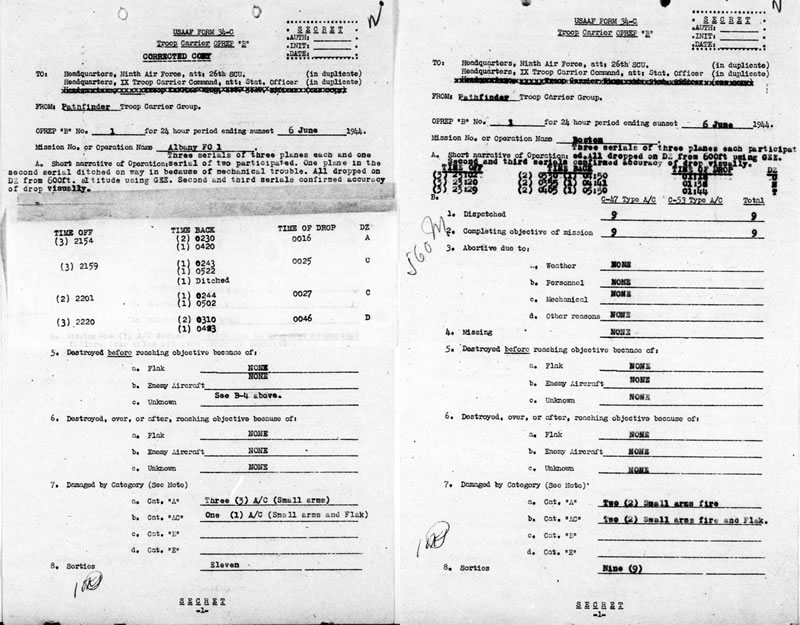
After the mission, all the men of the aircrew were awarded an Air Medal by General Order #39, Hq IX Troop Carrier Command, issued July 6, 1944 except pilots who were serial leaders and were awarded a Distinguished Flying Cross by General Order #179, Hq Ninth Air Force, issued July 14, 1944.
Concerning the paratroopers, the Pathfinders of the 82nd and 101st Airborne Divisions present in Normandy received a bronze star by General Order Nb. 39, Hq 82nd Airborne Division, published on July 21, 1944 and by General Orders Nb. 19, 20 and 21, Hq 101st Airborne Division, published on July 14, 15 and 16, 1944.
Pathfinders were also used during following operations of WWII but their story is beyond the scope of this website.
Documents used for this article
 |
IX TCC Tactical Air Plan for Operation Neptune
2 May 1944 |
|
|
Field Order #1 Hq IX TCC
31 May 1944 |
|
|
Appendix D1 to F.O.#1 - 31 May 1944
Time Schedule - Missions Albany, Boston, Chicago, Detroit |
|
H-Hour Minus Four & a Half |
|
|
IX Trop Carrier Command Pathfinder Flash Reports |
|
|
Mission summary of Gee result |
|
Pathfinder Troop Carrier OPREP "B" |
|
|
Report on the mission of the Pathfinder Aircraft - Operation Neptune |
|
|
Sea rescue - Ditching of Chalk #4 |
|
Report on the paratroops operations of the N.A.Troop Carrier Command on the nights of 13th-14th and 14th-15th September 1943 |
|
|
Field Order #1 - 101st AB Division Pathfinder
31 May 1944 |
|
|
Training and tactical employment of Airborne Division Pathfinders |
|
Report of D-Day Pathfinder Activities
Frank L. Lillyman 1 July 1944 |
|
|
Report of Pathfinder Employment for Operation Neptune
Neil L. Mc Roberts 11 June 1944 |
|
|
D-Day Experiences of Pathfinder Charles L. Malley
Chalk #4 ditched in the Channel |
|
Operations of a Regimental Pathfinder Unit, 507th PIR in Normandy |
|
|
General Order #39 - Hq IX TCC
Air medal - 6 July 1944 |
|
|
General Order #179 - Hq Ninth Air Force
Distinguished Flying Cross - 14 July 1944 |
|
General Order #39 - Hq 82nd A/B Div
Bronze Star medal - 21 July 1944 |
|
|
General Order #19, 20, 21 - Hq 101st A/B Div
Bronze Star medal - 14 July 1944 |
|
|
|
Epilogue: Now you may have the opportunity, by going on the internet or during discussions among enthusiasts, to read or hear that a particular aircraft was the lead aircraft during the Normandy invasion and that she has been restored to flying condition. And the name "That's All Brother" will be put forward.
You have here all the necessary and official documentation to prove to these people that what they are saying is false and that ten C-47s of the Troop Carrier Command flew over Normandy before her. And the first one being Pathfinder aircraft #42-93098.
Thanks to Denis Van Den Brink for his participation and writing the part dedicated to genesis.
Patrick Elie October 2025
|